

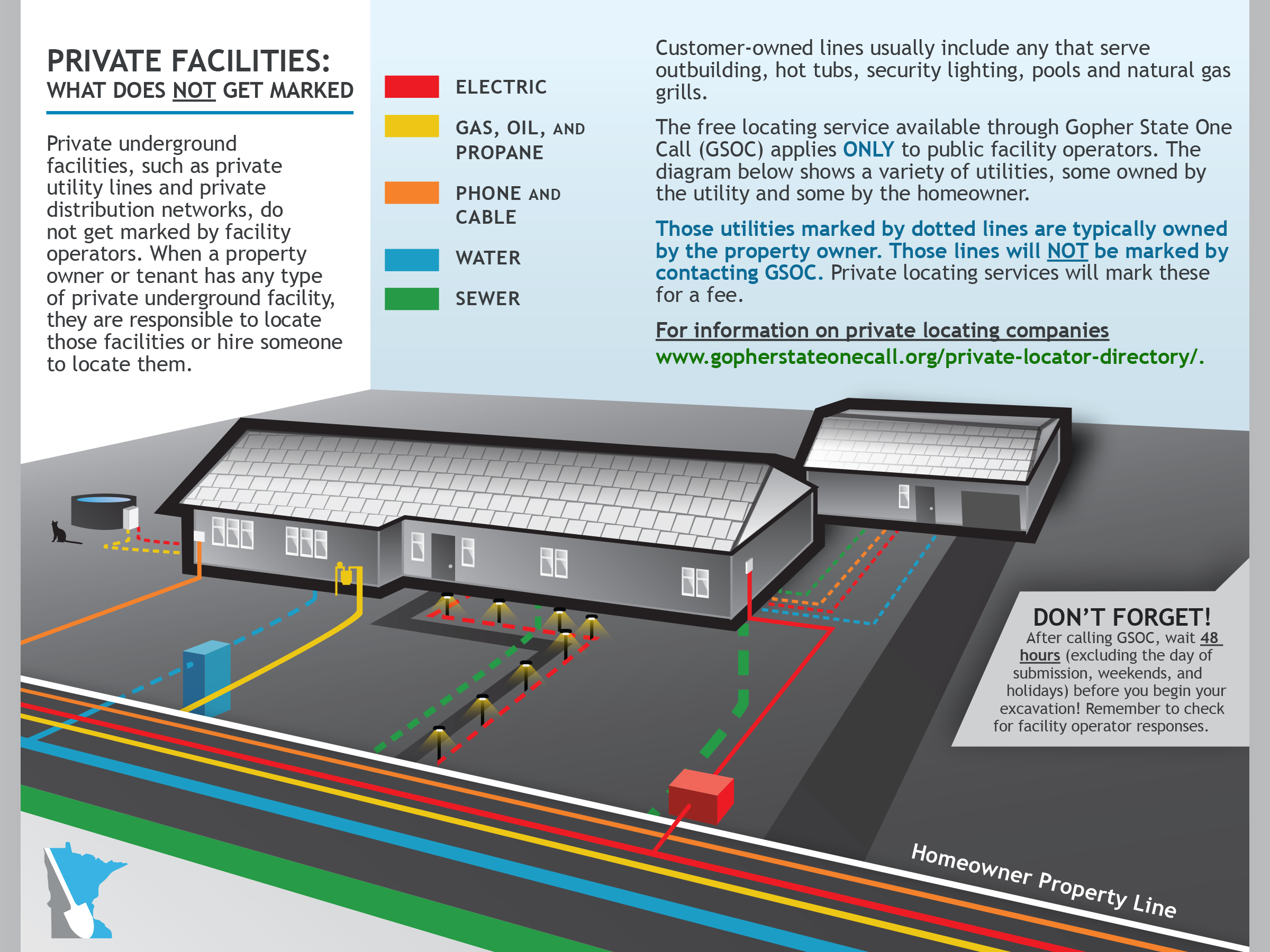
Privately owned and operated underground facilities are found everywhere, including single family homes, farms, multi-family housing units, businesses and industrial areas, mobile home courts, and sometimes in the road right-of-way. This means they can also be at your excavation site. Privately-owned facilities—such as utility lines that serve heaters for hot tubs, gas grills, electric security lighting, invisible dog fences, farm taps, and buried sprinklers systems—are not marked when locators respond to a Gopher State One Call (GSOC) locate request, and property owners or tenants are responsible for locating or hiring someone to locate any private underground facilities.
Are Private Facilities Marked After Submitting GSOC Locate Request?
GSOC encourages owners and operators of private underground facilities to include those facilities on the GSOC system, but ultimately most private underground facilities are not listed with the center and therefore not marked as a result of submitting a locate request. Because of this, unless the private facility owner participates in GSOC, private- or customer-owned facilities will not be notified and may not be marked. Therefore, it is imperative that special precautions be taken by excavators as part of every excavation project.
Are Facilities in the Public Right-of-Way Private Facilities? Marked with a GSOC Locate Request?
Facilities that run under or across public road right-of-way or any other public right-of-way are not “private facilities.” These facilities are “underground facilities” within the meaning of Minnesota State Statute 216D and must be registered with GSOC so that these lines will be marked as the result of a locate request. Please contact Customer Support at [email protected] if you need information about registering with GSOC as a facility owner.
What are Signs There Might Be Private Facilities in the Area?
If you are a landowner or a professional excavator digging on private property, there is a good chance that there are private facilities in your work area. Protect yourself by investing the time necessary to determine if there are private utility lines buried in your area of excavation. Look for above-ground warning signs such as a master meter, farm tap, or any former colored marks or flags. Contact whoever installed the lines to determine if any current records or maps exist of the area. Remember—a good excavator is also a mindful detective and investigator!
I Suspect There are Private Facilities at My Dig Site, What Should I Do?
The excavator and/or contractor should physically inspect the dig site prior to entering a locate request or even bidding on the job. Landowners, homeowners, and tenants should inform excavators about any private underground lines. In addition, it’s recommended to:
- Ask the property owner if they’re aware of any private lines
- See what equipment or power may serve buildings
- Contact the original installer of the facilities for any records or maps of the lines
- Visit gopherstateonecall.org and click on the “Private Locator Directory” under “Resources” for private locating company contact information
- Excavate with caution and be aware of any warning signs of underground facilities
Important: Excavating should be delayed until all private facilities are identified and professionally marked. When a property owner or tenant has any type of private underground facility, those facilities should be located and marked prior to breaking ground.
Common Types of Private Underground Facilities
Private facilities can be used to convey many different types of products, but in general, these products fall into two broad categories: energy-related facilities and non-energy related facilities.
Energy-related private facilities:
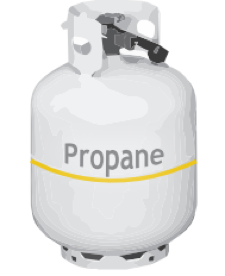
Propane is a fuel source used to heat residential buildings, swimming pools, grills, fireplaces, and appliances, among others. In agricultural settings, it can be a fuel source for buildings, corn dryers, and other equipment.Visible indications of the use of propane at a location are above ground or buried storage tanks.
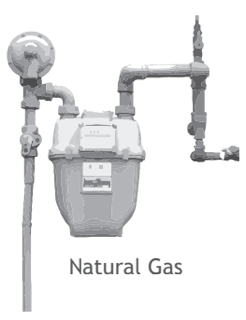
Natural Gas can fuel grills, pool heaters, yard lights, or heaters in outbuildings like sheds, garages, and barns. Natural gas may be delivered to a “master meter” at multi-resident properties, such as mobile home courts, townhomes, or apartment complexes. Buried facilities carrying natural gas between the master meter and units on the property are usually private facilities. As a general rule, natural gas providers will only mark underground gas lines from the main to the meter. Any appliance or device fueled by natural gas that is on the “other side” of the meter is almost invariably served by the private facility.

Electricity can also be supplied to a “master meter” to power multi-resident properties, such as trailer parks, town homes, or apartment complexes. These lines may connect outbuildings like garages, sheds, and barns to a source of power. Remember that the electric operators usually only mark the power lines up to the meter. If there is power in a garage or if a piece of equipment or building is served by electricity, make sure to look for a private electric line.
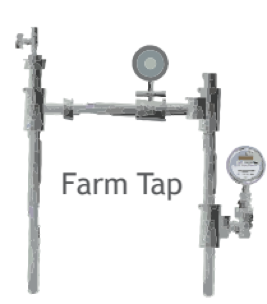
Farm Taps are private natural gas lines. All the equipment from the outlet of the meter (usually, but not always, located near the pipeline) to the house, corn dryer, milk house, or barn belongs to the landowner and will not be located. Farm taps support many farms, and as farms have expanded, adding more houses and buildings to the original farmstead, private lines attached to a single tap have increased. As the farm tap may not be evident from a visual inspection, all landowners should specifically be asked about the possible presence of these private gas lines.
Non-energy-related private facilities:
Some other types of private facility lines are underground sprinkler systems, data communications cables, fiber optic lines, septic systems, and waste collection lines, among others. In agricultural settings, drain tile and irrigation lines are often buried.
Who Can Mark Private Lines in Minnesota?
GSOC maintains a list of private locators operating in MN that can mark private lines. Please note that having private lines marked typically comes for a charge for the service. Click here to view the list of private locators.
If you have questions about private facilities, visit our What Does NOT Get Marked page or contact our Customer Support team at 651-681-7326 or send us an email at [email protected].